Victorian parents
Concerned about your child's NAPLAN results? Here's how Tuterly helps
5 August 2026
Start with what the result is telling you
If your child came back below the national average, or in the Developing band, the instinct is usually to book more of something. More tutoring, more worksheets, more hours.
That instinct is half right. Volume alone rarely moves a NAPLAN dot, because most below-average results are not caused by a lack of effort. They are caused by two or three specific skills that never quite landed, plus a test format nobody practises for.
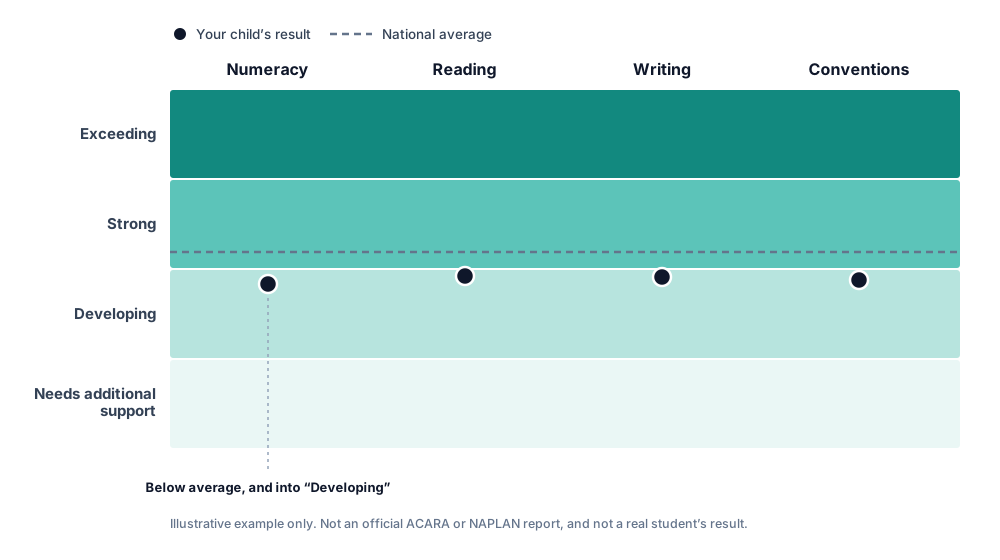
So the useful question is not "how much more work?" It is "which work, exactly?"
What we would actually do
1. Diagnose before teaching anything. The report is months old and tells you a band, not a skill. The first job is finding out where your child is now: a short test on the flagged topic, marked properly, with every mistake sorted into a silly slip, a genuine method gap, or a timing problem. Those three need completely different responses, and treating them the same is the most common way home study wastes effort.
2. Work the two or three real gaps. Not the whole subject. A student who is shaky on fractions and multi-step worded problems does not need Year 5 maths re-taught. They need those two things, properly, with spacing so it sticks.
3. Practise the way the test actually asks. This is the part schools rarely have time for. Class worksheets come sorted by topic, so your child knows the method before reading the question. Real tests mix topics, run to a clock, and lean on worded problems. For Years 7 to 10, Topic check in Tuterly writes a practice test across a whole topic, covering the same maths as the Victorian Curriculum, with a worked solution for every question.
4. Check it is working. Re-test the same topic a few weeks later with fresh questions and compare. If a tutor is involved, ask for a short note after each session on what was covered, how your child went and what to practise next. For Years 7 to 10 maths, linking to your child's Tuterly account gives you Week in review: what they added and mastered that week, their test scores and their trickiest topic. You should not have to wait for the next school report to find out whether the effort is paying off.
What tutoring cannot fix
Worth saying plainly, because plenty of tutoring companies will not.
- It will not turn a below-average result into Exceeding in a term. Real movement in maths takes a couple of terms of consistent work. Anyone promising faster is selling something.
- It will not help if the sessions are not backed up between times. An hour a week against five hours of school maths is not enough on its own. The practice between sessions is where most of the gain comes from, so the practice needs a plan, not a pile of loose worksheets. For Years 7 to 10 maths, that is what Tuterly is built for: the questions your child gets wrong become fresh practice questions until each one is mastered.
- It will not fix a confidence problem by itself. If your child has decided they are bad at maths, that belief needs addressing directly, and a good tutor spends real time on it.
- And plenty of children do not need a tutor at all. If the gap is small and your child will work with you, the free generator on this page plus twenty minutes twice a week may be all it takes. That is a genuinely fine outcome.
The honest summary
A below-average NAPLAN result is a useful early warning, not a verdict. The fix is specific rather than dramatic: find the two or three actual gaps, practise them in a spaced way, then rehearse under real test conditions. You can do that yourself with the free tools here, or bring in a tutor to drive it.
Either way, starting when the report lands in July, rather than the February before the next test, is what makes it comfortable instead of a scramble.
Related reading: your child is below the national average, how to close the gap and how to read your child's NAPLAN results.